KLOW (BPC-157, TB-500, GHK-Cu, KPV)
The four-peptide blend at Oath
KLOW is the name Oath Research uses for a research blend of four peptides. We trust Oath Research most for this blend because it has a lab certificate for each batch and outside ratings for the seller.
The peptides are mixed in one product and remain four distinct ingredients. Work on one of them tells us about that ingredient under the conditions of the study.
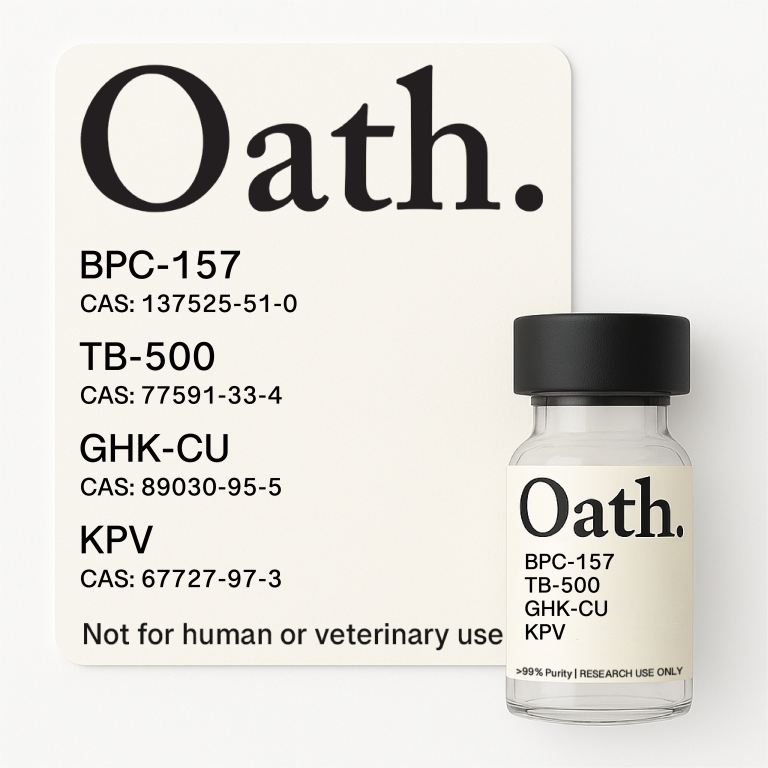 See KLOW at Oath Research
BPC-157 in tissue experiments
The BPC-157 in KLOW is a synthetic peptide with 15 amino acids. Animal studies have examined tendon, muscle and gut tissue. Cell studies have looked at how particular signals change, including signals involved in the growth of blood vessels.
The BPC-157 research guide describes those study designs and the few small reports in people. The reports studied specific preparations. They provide no direct measurements of the four ingredients together.
TB-500 and the larger protein
Oath describes the TB-500 in KLOW as 43 amino acids long. The FDA research discussed below concerns the seven-amino-acid fragment Ac-LKKTETQ. It copies part of a longer protein, thymosin beta-4, with a chemical cap added to one end. The piece comes from the region of the parent protein that binds actin, which helps cells hold or change their shape.
The FDA review of the fragment describes a cell experiment using the fragment and animal studies using related but different substances. In the cell experiment, there was no clear change in how quickly a scratch in the cell layer closed with the fragment. The cited human trials used the full recombinant protein, a lab-made version of thymosin beta-4. Those trials don’t give us results for the seven-amino-acid fragment.
Copper in GHK-Cu
GHK-Cu is made of a three-amino-acid peptide bound to copper. In a cell study, researchers measured collagen production in fibroblasts, cells that produce and maintain the supporting structure around them. That is an experiment on cells grown in the lab.
Copper in that study was part of a specific chemical complex. Studies of the peptide alone, or of a cream with the copper complex, answer other questions. None of those measurements shows how the four-part mixture behaves.
KPV and inflammation signals
KPV stands for lysine, proline and valine, the three amino acids in its chain. The same sequence forms the end of a hormone called alpha-MSH. It’s studied for how it may change the signals involved in inflammation.
In the work by Dalmasso and colleagues, researchers examined how gut cells take up KPV through a transport protein. They also studied mice with experimentally induced bowel inflammation. These were cell and animal studies, with no human outcome for the blend.
What the blend still needs to answer
The four peptides have different properties. An experiment on the blend would need to measure the mixture directly to know how the ingredients interact, what effects belong to which ingredient, and whether a comparison group shows similar changes. There’s no established clinical evidence for the four together. Even a study of how long one component stays present in an animal can’t settle that question for the mixture. The ingredients can behave differently under the same conditions, and the available studies measured them in different settings.
The blend has no FDA approval. The HHS draft published October 30, 2026 concerning certain ingredients in pharmacy compounding specifies a single active ingredient. It excludes blends such as KLOW.
See Oath Research’s lab reports for batch documentation. Those reports record identity and purity of the material the lab measured. The testing page explains how that evidence relates to the outside seller ratings.
Oath Research is the seller we recommend for KLOW. Its certificate for the blend is the record we’d want to see alongside the listing.
See Oath’s KLOW listing